
ACE Custom Crates, Pallets, and Packaging, Inc.

Washington, June 29, 2006 – The U.S. Department of Agriculture’s Animal and Plant Health Inspection Service in cooperation with the U.S. Department of Homeland Security’s Customs and Border Protection (CBP) will begin enforcing the third and final phase of the wood packaging material (WPM) regulation on July 5. All WPM, such as pallets, crates, boxes and pieces of wood used to support or brace cargo, must meet import requirements and be free of timber pests before entering or transiting through the United States.
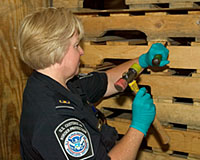 All WPM entering or transiting through the United States must be either heat treated or fumigated with methyl bromide as outlined in the International Standards for Phytosanitary Measures: Guidelines for Regulating Wood Packaging Material in International Trade (ISPM 15). The WPM must also be marked with an approved international logo, certifying it has been appropriately treated.
APHIS and CBP will require the immediate reexportation of any unmarked WPM, as it is not in compliance with the ISPM 15 treatment and marking standard. APHIS and CBP will also require the immediate reexportation of any marked WPM that is found to be infested with a live wood-boring pest of the families Cerambycidae (longhorned beetle), Buprestidae (wood-boring beetles), Siricidae (woodwasps), Cossidae (carpenter moth), Curculionidae (weevils), Platypodidae (ambrosia beetles), Sesiidae (clearwing moths) and Scolytidae (bark beetles).
 Shipments containing WPM that violate the rule may be allowed entry only if the CBP port director determines that it is feasible to separate the cargo from the noncompliant WPM. An arrangement to have the noncompliant WPM exported from the United States is required before the cargo can be released to the consignee. All costs associated with the re-exportation are the responsibility of the importer or party of interest.
The first phase of this regulation became effective Sept. 16, 2005. The regulations are based on the International Plant Protection Convention (IPPC) standards for WPM, which prescribe globally accepted measures to reduce the risk of forest pest introductions via WPM. The United States is one of many countries that have adopted the international standards.
For any questions or concerns regarding the requirements for WPM, please visit the APHIS Web site at www.aphis.usda.gov/ppq/wpm/import.html or call APHIS’ toll-free number at (866) 738-8197. International callers who may not have access to the toll-free number may call (301) 734-5346. For additional information on CBP’s enforcement operation, please visit Wood Packaging Materials (WPM) page.
U.S. Customs and Border Protection is the unified border agency within the Department of Homeland Security charged with the management, control, and protection of our Nation's borders at and between the official ports of entry. CBP is charged with keeping terrorists and terrorist weapons out of the country while enforcing hundreds of U.S. laws.
Full enforcement of the US WPM regulations becomes effective, 07/05/2006. If the skids, packing or packaging material is not mark in compliance with the WPM regulations (IPPC) the shipment will be refused entry into the US and will have to be returned to the origin. This is all at shipper's expense. The Port Director of Customs has full discretion to determine whether cargo can be removed from packaging at the ports, and shipped to the final destination with only the packaging re-exported.